Extract two capability vectors
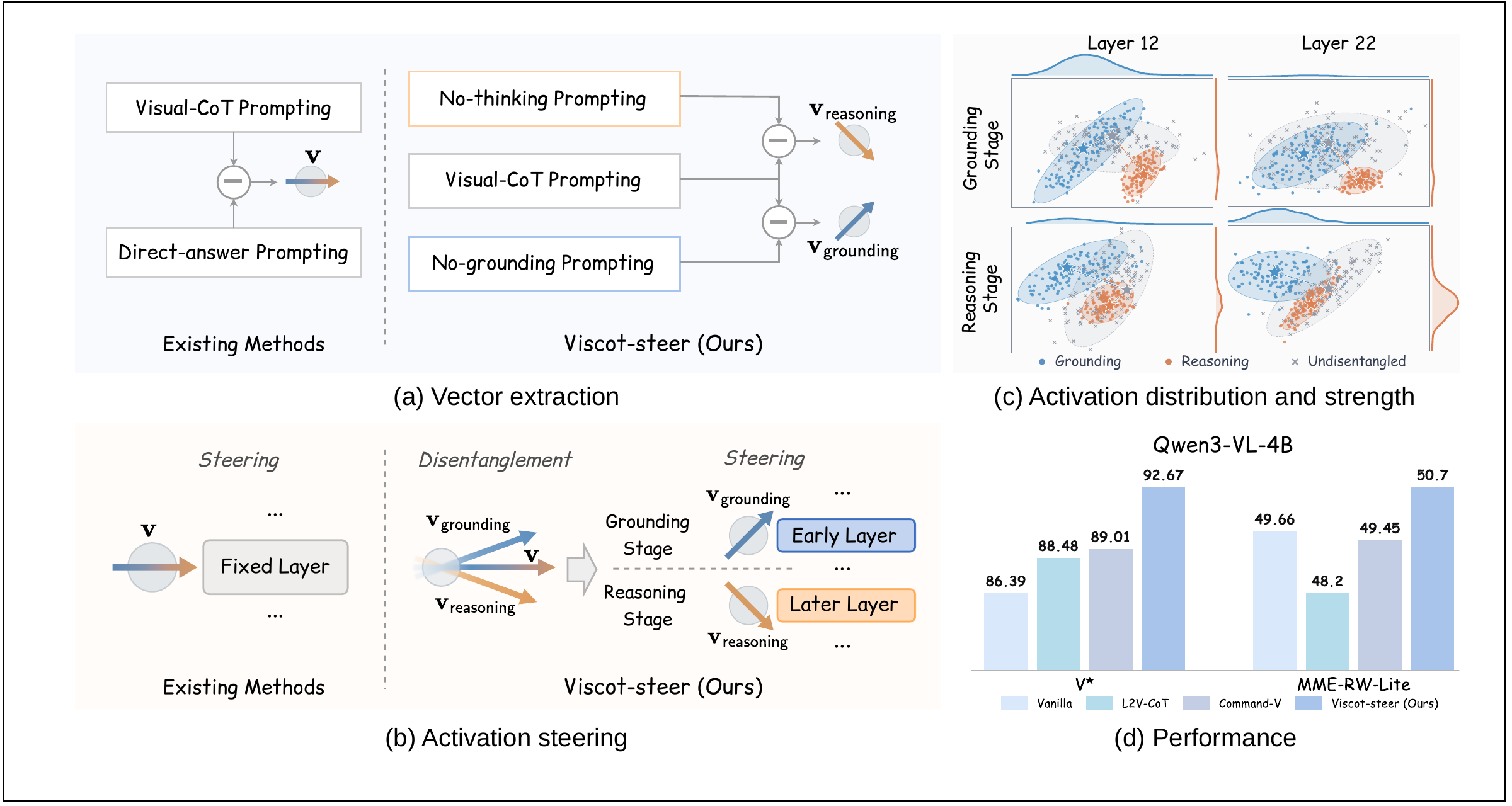
Keep the image and question fixed. Compare visual-CoT prompting with a no-grounding or no-reasoning counterpart, and average activation differences at capability-specific source layers.
Visual Chain-of-Thought · Activation Steering
Transfer “thinking with images” to a new model.
Separate what to transfer, where to steer, and when to intervene.
Transfer visual-CoT without retraining. Extract separate grounding and reasoning vectors, align them across models, and steer each one only at the layer and generation phase where it is needed.
The research question
“Thinking with images” is powerful. Relearning it for every backbone is expensive.
Viscot-steer transfers these capabilities through inference-time interventions in hidden activations.
The framework
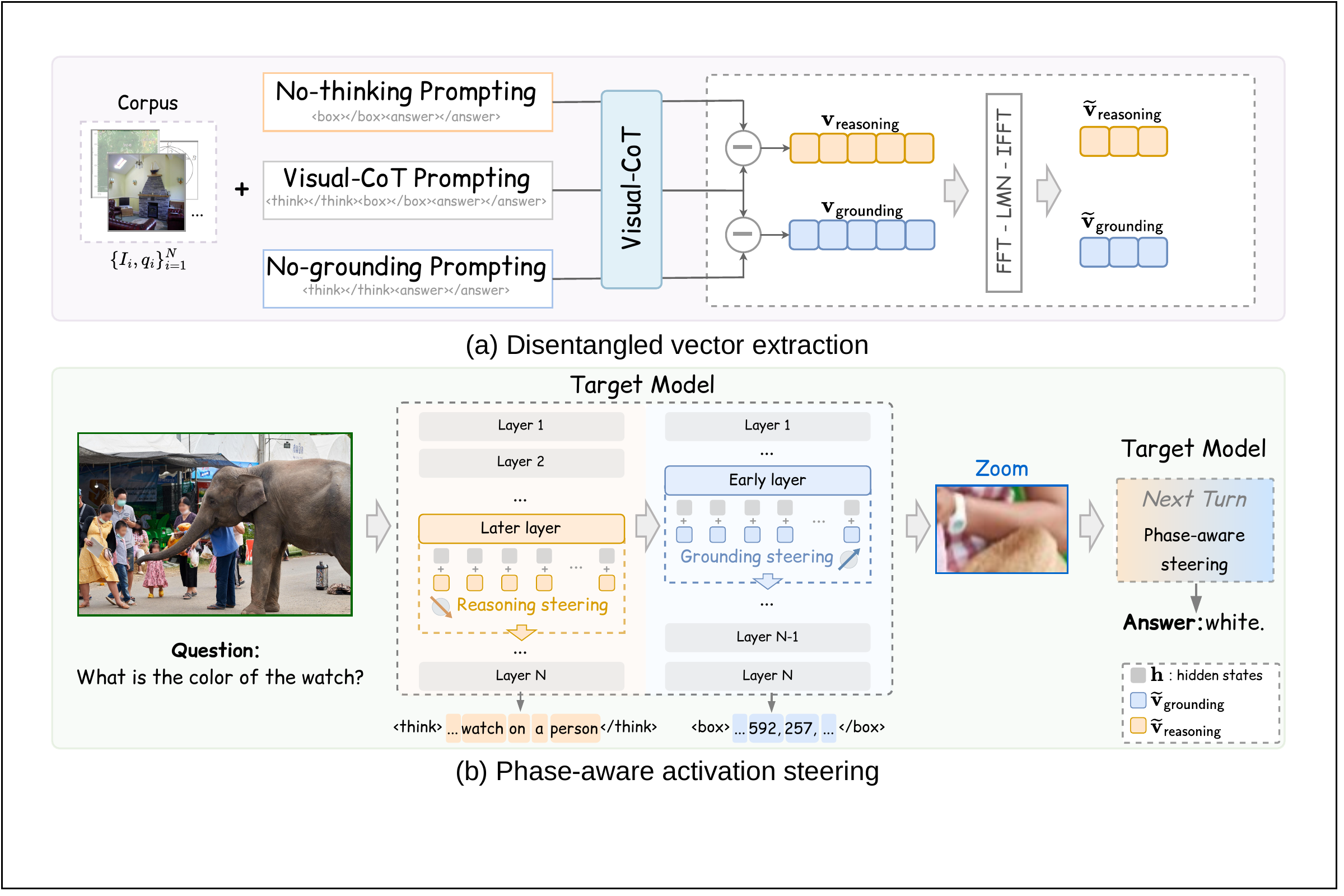
Keep the image and question fixed. Compare visual-CoT prompting with a no-grounding or no-reasoning counterpart, and average activation differences at capability-specific source layers.
Use LMN frequency-domain resampling to match the target hidden dimension, then restore the source-vector norm. Neither the source nor the target model is updated.
Inject the grounding vector during bounding-box prediction and the reasoning vector during reasoning-trace generation. Leave final-answer generation unsteered.
Explore the routing policy
Experimental evidence
DeepEyes-7B is the source model. Target models span Qwen2.5-VL, Qwen3-VL, and InternVL2.5, from 3B to 32B parameters. All scores below are overall benchmark scores in percent; higher is better.
Main-text results: Qwen2.5-VL-7B, Qwen3-VL-4B, and InternVL2.5-8B. The 3B and 32B results are from the appendix. HR-Bench 4K and 8K are settings of one benchmark. Bold marks the highest score among the displayed methods.
Qwen2.5-VL-7B improves from 75.92% to 93.72% on V*, exceeding the DeepEyes-7B source model’s 88.48% in this setting.
InternVL2.5-8B rises from 36.25% to 50.38% on HR-Bench 4K. Its MathVista score also improves from 58.0% to 61.5%.
With GRIT-3B as the source, Qwen3-VL-4B improves from 55.96% to 64.26% on VSR and from 51.53% to 54.58% on TallyQA. InternVL3-2B also improves on both benchmarks, although L2V-CoT scores higher on VSR (48.01% vs. 46.57%).
Why it works
Qualitative examples
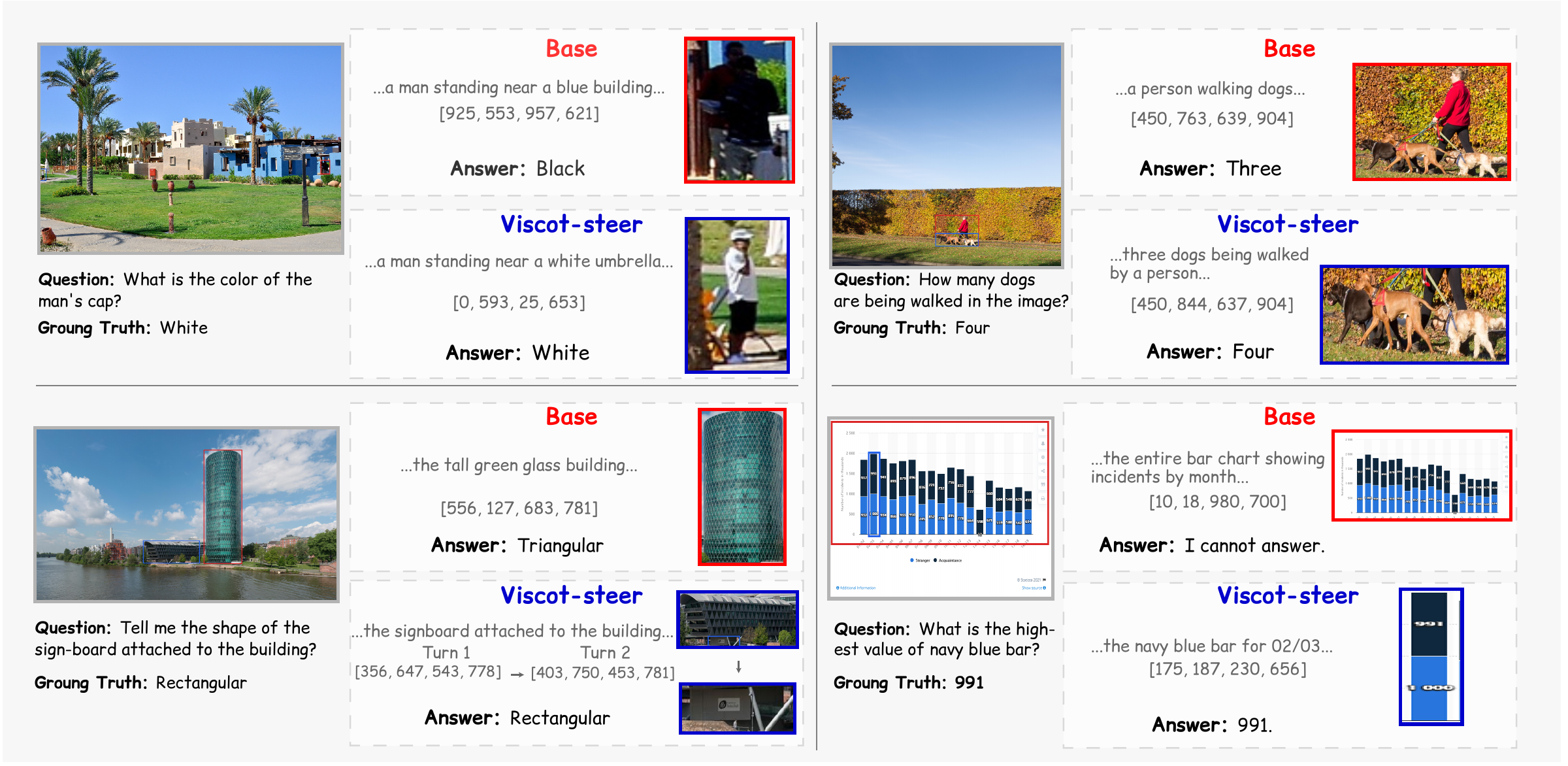
The manuscript compares base-model and steered responses on fine-grained attributes, counting, sign recognition, and chart reading. The examples show how changing the attended region can correct the final answer.
Scope & reproducibility
Training-free means the transfer process updates no model parameters. It still requires source-model activations, contrastive extraction examples, and inference-time steering.
Grounding and reasoning layers are chosen separately. The manuscript provides steering-layer and strength analyses; improvement is not uniform across every model and benchmark. For example, Qwen3-VL-32B stays at 78.1% on MathVista, below L2V-CoT’s 79.4%.
The main extraction setup uses 1,000 examples from DeepEyes-Datasets-47k, covering real-world, mathematical, and chart reasoning. Detailed prompt and hyperparameter settings are described in the manuscript appendix.
Reference
Manuscript citation. Publication details and a persistent URL can be added when available.
Download BibTeX ↓